
Global unit shipments of PCs and smartphones were both down versus a year ago in the 2nd quarter of 2026, according to IDC. PCs were down 4.9% and smartphones were down 6.7%. Both PCs and smartphones showed growth in 2024 and 2025. IDC is predicting an 11.3% decline in PCs and a 13.9% decline in smartphones in 2026.
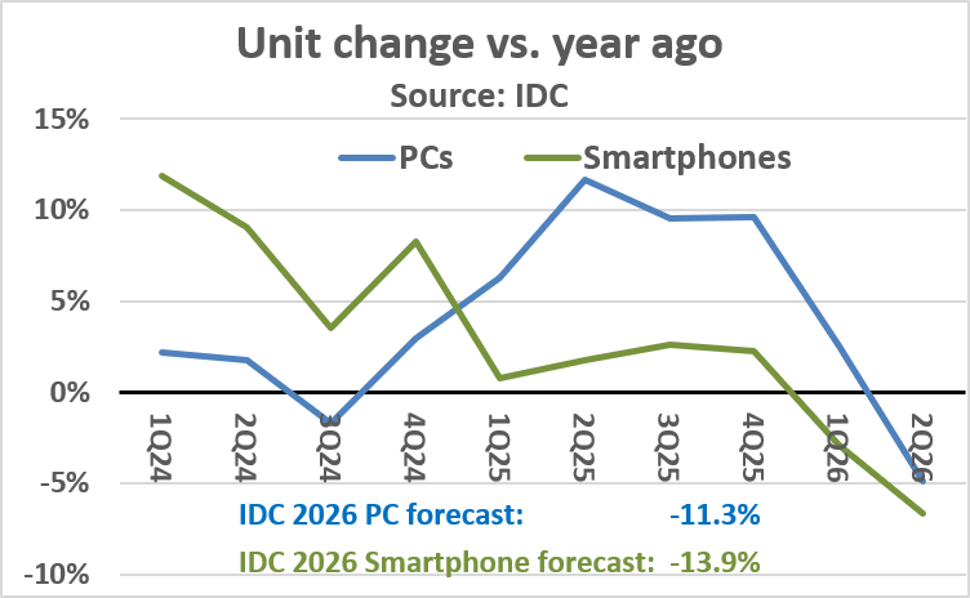
What is causing the decline in shipments? It is not lack of demand, but lack of supply. Memories, processors and other semiconductor devices are in high demand for AI applications – thus limiting their availability for other applications.
Apple’s latest 10-Q report for its quarter ended in March 2026 stated: “The Company is experiencing a period of supply constraints and increasing costs for components . . . including advanced semiconductors, storage (NAND) and memory (DRAM).” HP’s earnings conference call for its latest quarter ended in April reported: “In Q2, as anticipated, memory and storage costs increased sequentially. We expect this trend to continue in the second half of 2026.” Dell’s earnings conference call for its quarter ended in May stated: “We have a supply issue. We are supply constrained in the second half. It is not a demand issue for us.”
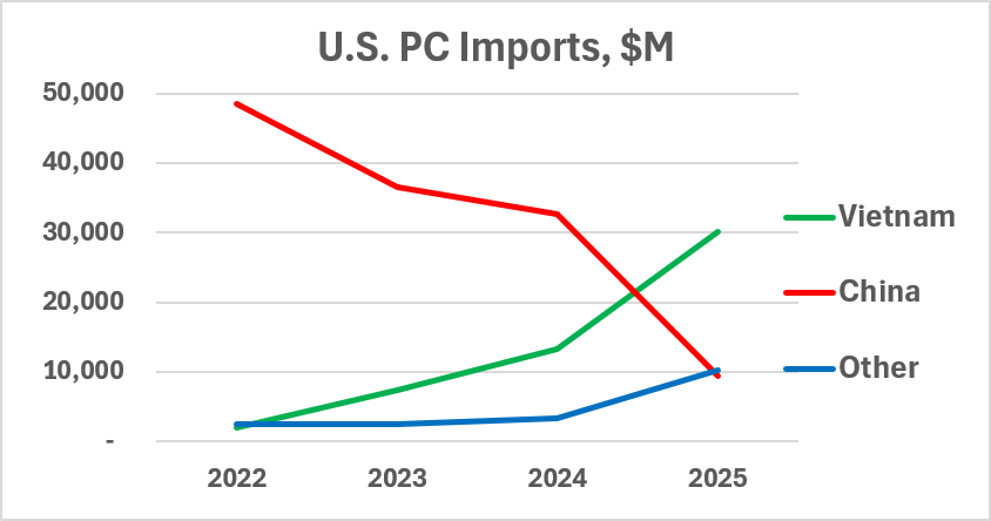
As shipments of PCs and smartphones have dropped, there has also been a shift in U.S. imports over the last few years. China has been subject to political pressure and on-and-off tariffs from the U.S. As a result, production has shifted to other countries. In 2022, China accounted for 92% of U.S. PC imports. In 2025, only 19% of imports came from China, with 60% from Vietnam. Several PC makers have been shifting production from China to Vietnam and other countries, including HP, Lenovo, Apple, Asus, and Quanta.
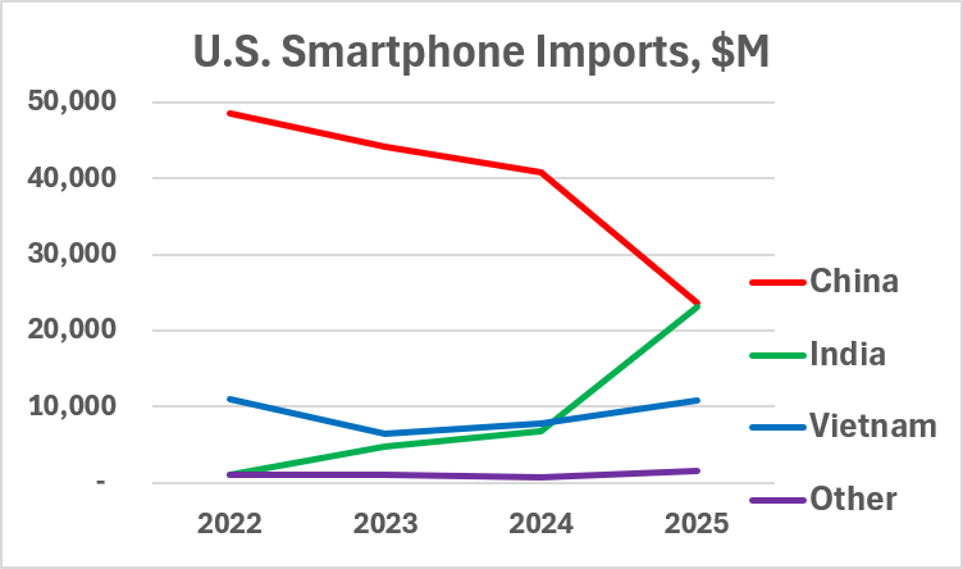
U.S. imports of smartphones have shown a similar trend. Imports from China accounted for 79% of the total in 2022, dropping to 40% in 2025. Meanwhile, India moved from 2% of U.S. smartphone imports in 2022 to 39% in 2025. For the first five months of 2026, smartphone imports from India are over twice the value of imports from China. Smartphone companies manufacturing in India include Apple, Samsung, Xiaomi, Oppo and Vivo.
An interesting trend in U.S. imports is the HTS category 84150: DIGITAL PROCESSING UNITS OTHER THAN THOSE OF 8471.41 AND 8471.49, N.E.S.O.I. Basically, these are computer units which are not complete systems and do not include an input or output device. This category has exploded over the last few years, from $37 billion in 2023 to $165 billion in 2025. The category is larger than the combined $109 billion in smartphone and PC imports in 2025. 49% of the imports in this category came from Mexico and 42% came from Taiwan.
The HTS 847150 category is certainly dominated by AI processors from Nvidia. Imports in this category grew over four times from 2023 to 2025 which matches Nvidia revenue growing 3.5 times over the same period. Nvidia’s AI processors are made by TSMC in Taiwan. Foxconn has factories in Mexico to assemble Nvidia’s AI processor into modules. Nvidia sells the modules to companies which manufacture the AI systems.
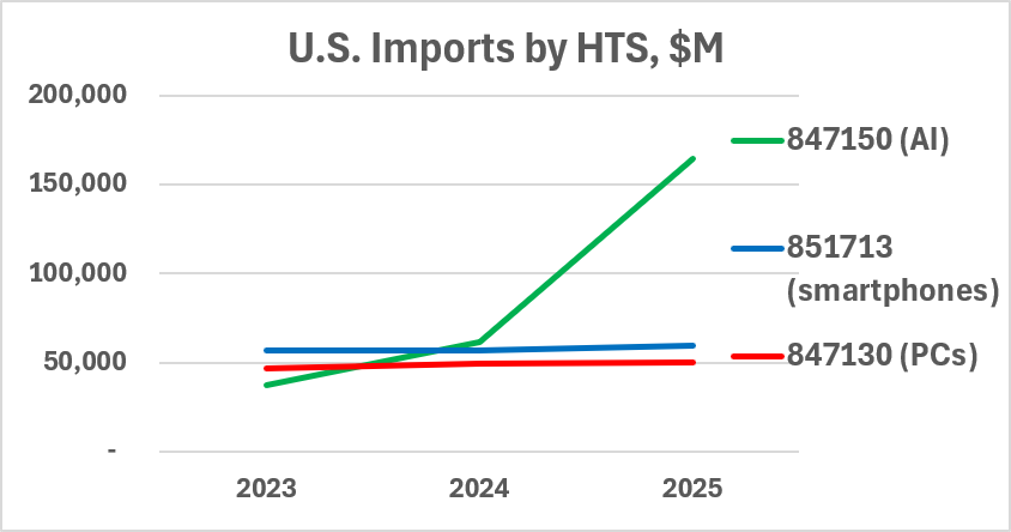
The import data reflects the dominance of AI applications. AI demand for memory and processors is hurting supplies for other applications. PCs and smartphones are the hardest hit since they are heavily dependent on memory and processors. How long will this continue? The AI boom shows no signs of slowing down. Micron Technology and Samsung Electronics are both doubling capital expenditures this year versus last. But adding memory capacity takes time. It will probably take at least two years before the situation is resolved through increased memory capacity, AI demand leveling off, or a combination of both.