
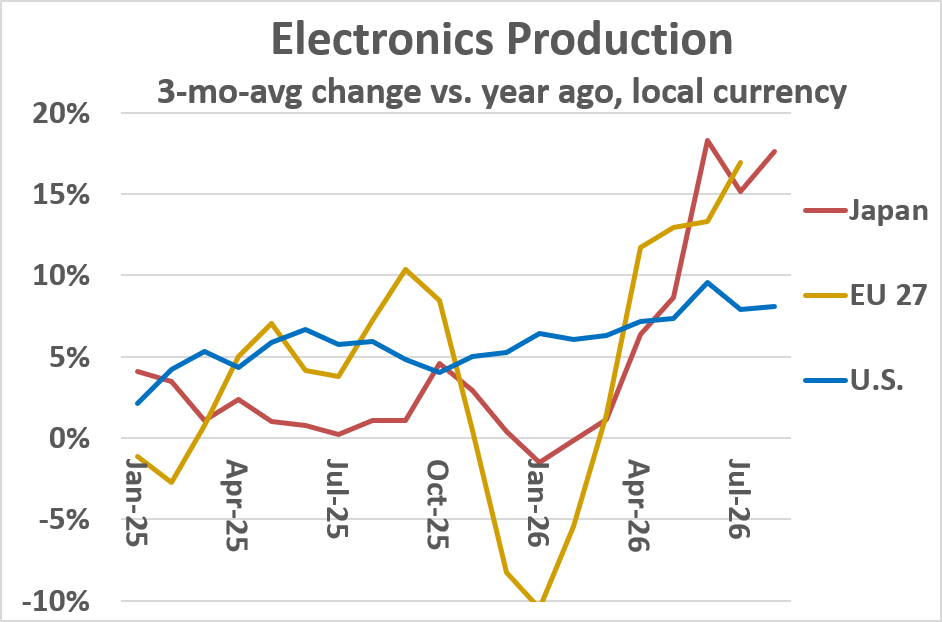
Growth in electronics production has been accelerating in 2026. Three-month-average change versus a year ago for electronics production in the U.S. was 8.1% in August 2026, continuing an accelerating growth trend since October 2025. Japan and the 27 countries of the European Union (EU 27) showed much stronger growth acceleration. Japan production growth went from a 1.5% decline in January 2026 to a 17.6% increase in August 2026. The EU 27 moved from a 10.5% decline in January 2026 to 16.9% growth in July 2026.
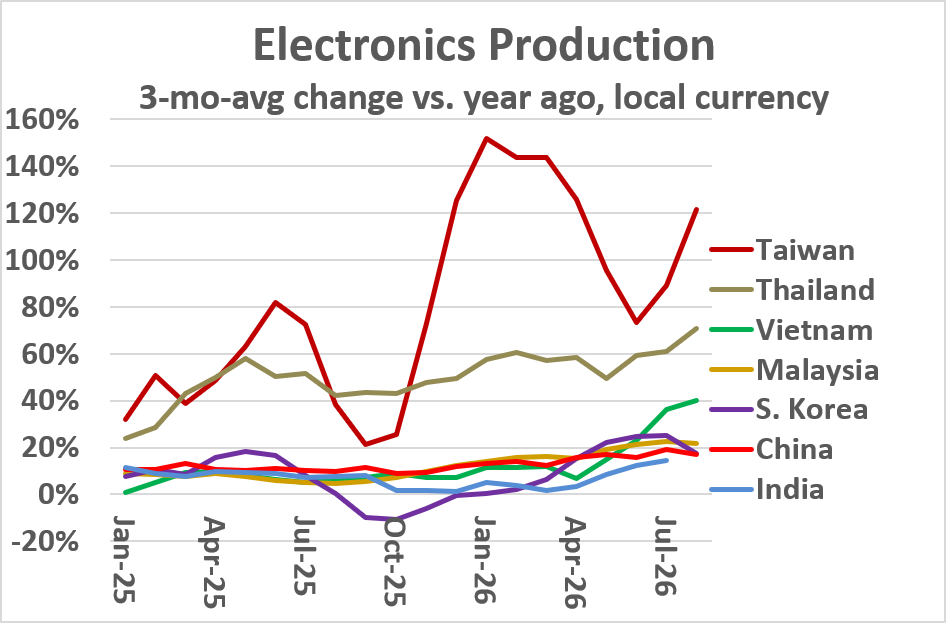
Electronics production growth is also accelerating among the major Asian countries. Taiwan showed phenomenal growth in 2026 with three-month-average change versus a year ago over 100 percent for most months of 2026. Taiwan’s electronics production has more than doubled in 2026, driven largely by demand for Nvidia AI modules. TSMC manufactures the ICs and other Taiwanese companies assemble the ICs and other components into modules.
Other key Asian countries are also showing healthy increases in electronics production. Three-month-average change versus a year ago in August 2026 was 71% for Thailand, 40% for Vietnam, 22% for Malaysia, 18% for South Korea, and 17% for China. India was up 14% in July 2026.
Despite the global strength in electronics manufacturing, shipments of two key end equipments – PCs and smartphones – have dropped significantly in the last quarter. According to IDC, PC shipments in the 3rd quarter of 2026 were down 20% from a year ago. Shipments of smartphones were down 22%. For the year 2026, IDC projects PC shipments will decline 11.3% and smartphones will drop 13.9% The declines are primarily due to shortages and pricing of memory. AI applications are driving huge demand for memory and pushing up memory prices for both DRAM and flash memory. According to IDC, memory costs in 3Q 2026 were up 350% from a year ago.
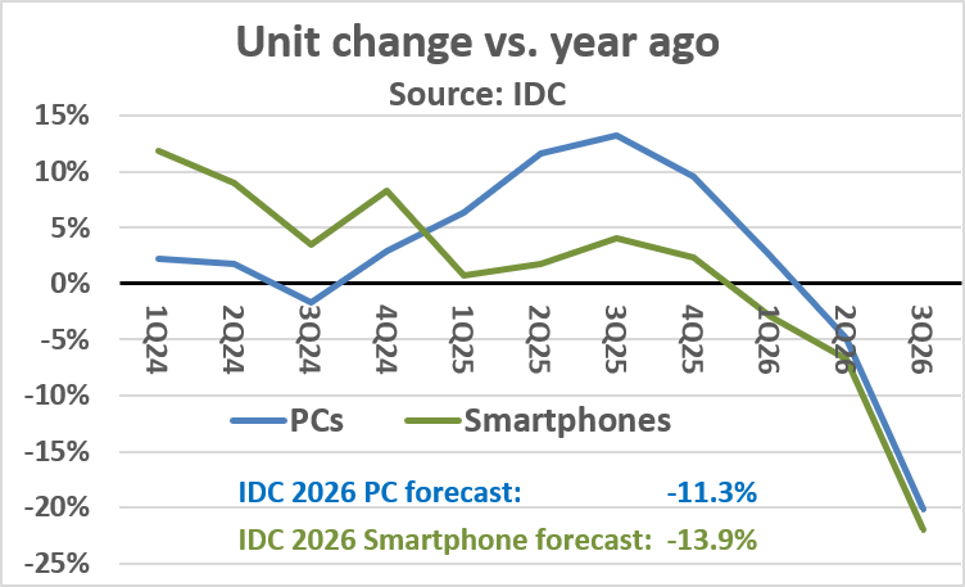
The boom in AI is behind the high growth rates in electronics and semiconductors. However, AI demand is resulting in declines in other electronics markets.